Monday, April 18, 2022

John Fowler Smith - A Buckie Loon Does Porridge at Perth and Peterhead


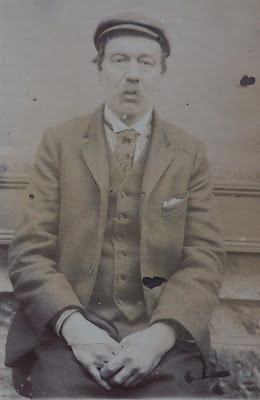
John Fowler Smith was a light-fingered farm servant who first appeared in court in August 1904 charged with a number of thefts. The Aberdeen Daily Journal reported the case in its edition of the 18th August as follows, 

"John Fowler Smith, a farm servant with no fixed place of residence, was examined in chambers in Aberdeen yesterday before Hon. Sheriff-Substitute James Murray of North Inveramsay, in connection with a series of charges. Smith is alleged to have stolen 30s. from the dwelling house on the croft at Hill of Bandode, Midmar, on 1st of September last; a quantity of clothing from a shed at Whinnypark Cottage, Birse, on the 8th or 9th inst., and a jacket from a shed at Marywell Cottage, Birse, and a quantity of clothing from the bleaching green adjoining. The offences were denied and Smith was remitted for further examination".

Frustratingly, the results of this "further examination" do not appear to have been reported in the press. However, on searching the Perth Prison Registers (which have recently been made available through Scotland's People) we find that John Fowler Smith was admitted as a prisoner there nearly two years later, on the 9th May 1906 following a trial for theft by house breaking at Kinross. For this crime he was given a 12 month sentence. He was 25 years of age, with his birthplace listed as Buckie. His height was 5 feet 7 inches, his occupation given as a "labourer" and was in good health with 20 previous convictions.

Although liberated from Perth on the 21st May 1907, Smith found himself back inside the same prison later that year, being incarcerated on the 28th December 1907. On this occasion he had been sentenced to 18 months at Forfar Sherriff Court for theft by housebreaking. The Perth Prison Register further reveals that he was liberated to Bridge of Allan on the 26th June 1909.


Detail from the Perth Prison Register showing the entry for John Fowler Smith, incarcerated on 28th December 1907
(National Records of Scotland: HH21/47/13)


Once again, Smith remained at liberty for only a short spell of time receiving a sentence of five year's penal servitude in September 1909 for a series of thefts from farms in Fife and Perthshire. On this occasion it appears that he served the majority of his sentence at Peterhead prison where he appears as an inmate on the 1911 census.


Detail from the 1911 census return for Peterhead showing John Fowler Smith as an inmate at the prison 

Although the census records that he was single in 1911, it is apparent from his death certificate dated May 24th 1933 that John married a Helen Ann Sievewright at some point after his release from Peterhead and that their address was 610 Holburn Street, Aberdeen. The certificate further reveals that he was an engineman on a trawler at the time of his death and that he died as a result of acute pneumonia. 

Tuesday, March 8, 2022

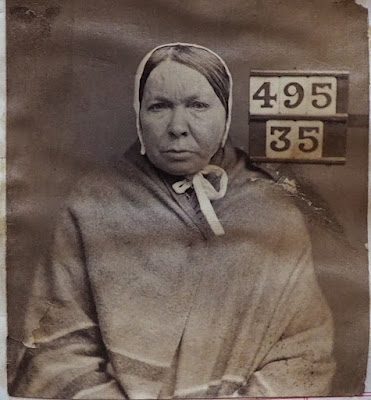
Grace McIntosh - The Life of a Victorian Criminal


Since Grace McIntosh first appeared in the Criminal Portraits blog, many more details about her life have been discovered which are now included in this expanded post. Grace's life-story was the subject of a recent talk at the Granite Noir crime writing festival by myself and Dr. Dee Hoole of the University of Aberdeen whose research into the Aberdeen Prison Registers and other original records has unearthed many of the additional facts. My thanks to Dee for helping tell this amazing story.

Friday, January 21, 2022

James William Lumsden - The Fraudster, a.k.a. "Wigs"


The album into which this image is pasted contains a note in pencil directly above the mugshot that reads,

"James William Lumsden "Wigs", oft.-convicted Aberdeen thief and fraudster. Obtained goods by writing fraudulent letters".

Every "good" criminal needs a nickname and "Wigs" is a particularly great one. How he came by this moniker becomes apparent when reading the report of his trial in the Aberdeen Daily Journal of the 11th October 1904, under the headline "The Extraordinary Frauds in Aberdeenshire", 

"Before Sheriff Robertson at Aberdeen yesterday, James William Lumsden, joiner, of no fixed residence, was charged with nine different acts of fraud committed in Aberdeen and in Peterhead, Fraserburgh, and other parts of the Buchan district. The frauds consisted in getting articles by means of false letters and of getting board and lodgings by plausible but untrue statements to landladies, whom he succeeded in duping. A number of previous convictions were recorded against Lumsden, who pleaded guilty".

"Mr. J.B. Rennett, advocate, who appeared on the accused's behalf, stated that there was one charge to which the accused did not plead guilty".

"The Fiscal (Mr. Thomas MacLennan) - That is the charge in regard to the wig; but the fact is that the man was wearing the wig when he was apprehended. (Laughter)."

"Mr Rennet - it is the charge in regard to obtaining clothes from Mr. Henry Gray. The Fiscal - I am prepared to accept that. The Sheriff - Eighteen months' hard labour".

The scanty personal details that the report provides about "Wigs" mean that it has been impossible to identify him with any certainty in the 1901 census. However, it is quite possible that he is the James Lumsden, a joiner, born "about 1855 in Tarves" living at 7 Lemon Street, Aberdeen, with a wife and three children.


Monday, December 20, 2021

Ephraim Jacob Feldman - "The Silk-Hatted Prisoner"


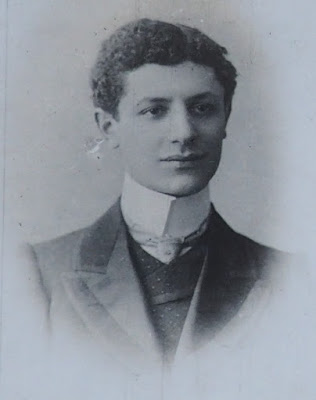
The picture of Ephraim Jacob Feldman is no mugshot, but rather a posed, formal portrait. It shows Ephraim as a dapper, well dressed young man, an impression which is born-out by the report of his trial which appears in The Daily Record and Mail of Saturday 15th April 1905 under the headline "Silk Hatted Prisoner - Young Man Who Traded in Golf Requisites":

"Ephraim Jacob Feldman, a young man of stylish appearance, amazed those who were witnesses of the proceedings yesterday in Glasgow Sheriff Court. When his name was announced he jauntily stepped into the dock, and while the indictment of fraud, with which he was charged, was being read out, he was seen calmly smoothing his silk hat, then adjusting his prince-nez, and generally tending to his dress, with the apparent object of emphasising the perfection of his sartorial outfit.

While Feldman seemed to have the knack of decking himself in the most up-to-date fashion, he was also possessed of the very questionable gift of defrauding unsuspecting shopkeepers...in Glasgow, Perth and Aberdeen. The goods obtained mainly consisted of golf requisites, and included the latest productions in balls, clubs and bags".

The newspaper report goes on to describe how Feldman offered to return the goods to the firms he defrauded, as well as repaying the majority of the outstanding £50 that he owed to other creditors. However, the Sheriff was not impressed and sentenced Ephraim to nine months' imprisonment. 

In the album containing Feldman's photograph, a note above the image states that his address was "18, Featherstone Buildings, London", which is located in Shoreditch, towards the East End. This part of London was well known for its large population of Jewish immigrants during the latter part of the nineteenth and into the twentieth century. His unusual name is further evidence that his ancestry derived from this community.  

A search of the 1891 census for Shoreditch reveals that Ephraim was one of seven children born to Simon and Frances Feldman. Frances was an East End girl, having been born in Whitechapel, but Simon, an auctioneer and boot manufacturer, had been born in Poland and had probably fled the persecution of Jewish people that swept across that part of Europe after 1880.

Granite Noir - 24th-27th February 2022


Aberdeen's annual festival of crime writing, Granite Noir, takes place next February. I'm delighted to have been asked to contribute again and will be giving a talk, alongside Dr. Dee Hoole of the University of Aberdeen, at the Cowdray Hall at Aberdeen Art Gallery. We will be focussing on the fascinating life story of Grace McIntosh who has previously featured in this blog. You can find the full programme for Granite Noir here....

Sunday, November 28, 2021

John Wilson - A Faded Mugshot


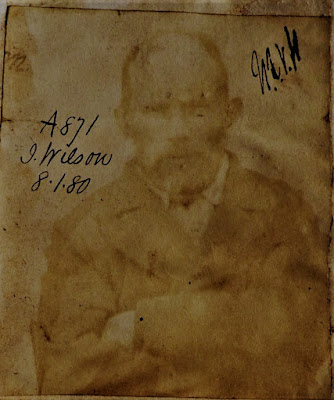
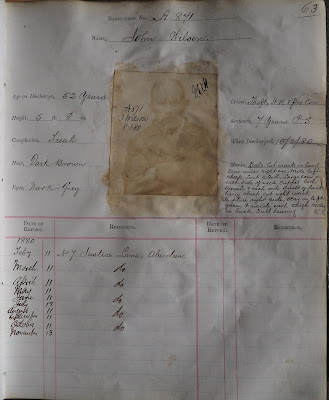
Taken on the 8th January 1880, probably in HM General Prison, Perth, the photograph of John Wilson that appears in the Register of Returned Convicts for Aberdeen is extremely faded. With the help of modern photo-editing, I have managed to manipulate the image so that you can just about make out his features, originally captured by the camera over 140 years ago. 

To compensate for the poor quality of the photograph, the details regarding John Wilson's 'distinguishing marks' that are written alongside are unusually comprehensive and provide a vivid description of his features:

"Bald. Cut mark on head. Scar under right eye, mole left cheek. Lost 4 teeth. Large scar on each side of neck. Cupped both breasts and each side of small of back, hairy chest, cut right wrist. Rupture right side, scar on left groin and inside each thigh, moles on back. Dull hearing".  

The reference to cup marks on his chest and the small of his back suggests that he may have suffered physical trauma in childhood, with the various other scars further indicate that he led a somewhat eventful life.

Wilson was a habit and repute thief. The reason why he was in prison when his photograph was taken is revealed by a short report in the Aberdeen Journal of the 29th April 1874, 

"John Wilson was charged with theft, on 6th March last, of two shirts, a handkerchief, razor, two scarfs, a leather belt, and a quantity of writing paper and envelopes, from the house of James Farquhar, Richmond Lane, Huntly. The panel is habit and repute, and has been three times convicted before a Sheriff and Jury, viz., once at Inverness and twice at Aberdeen. He pleaded guilty and was sentenced by Lord Deas to Seven Years' Penal Servitude".  

The Register of Returned Convicts for Aberdeen shows that Wilson stayed at 7 Justice Lane when he was released on 10th February 1880 (see image below). He remained at this address, which is located just off the Castlegate, until at least November of that year. Although we cannot be 100% certain as to what happened to him after this date, there is a John Wilson of precisely the right age who appears as an inmate of the Old Machar Poorhouse on the 1881 census. If this is indeed "our John", which seems likely, then he was born in Aberdeen in around 1828 and was formerly a linen weaver to trade.


Friday, October 29, 2021

Margaret Isabella Reid - "The Buchan Heiress"


An unwelcome feature of modern life is the telephone cold-call, with the person at the other end of the line often spinning a credible yarn in an attempt to extract personal or bank details from the unsuspecting recipient. Of course, fraud is nothing new, but it does require a particular confidence, skill and sheer brass neck to be able to pull it off in-person, in the way that Margaret Isabella Reid did.

Margaret's nickname was "The Buchan Heiress", a nod to her preferred tactic of pretending to be from a well-to-do or well-connected background as a way of gaining the confidence of those that she intended to defraud.

Evidence from the newspapers of the time suggests that her career of criminal trickery lasted from 1888 through to at least 1904. Many of the contemporary newspaper reports remark on her beauty and stylish dress-sense, being written with a degree of both fascination and respect for her utterly brazen behaviour. For example, The Aberdeen Evening Express of 10th December 1888 compared her to the notorious Victorian con-woman, "Mrs. Gordon Baillie", reporting that, 

"An extraordinary series of impudent frauds, displaying courage and cunning of no ordinary kind, was brought to light in Aberdeen Police Court today. The perpetrator is a rather good looking and demure damsel of twenty-four who is known by the name of Margaret Reid, and follows the humble occupation of domestic servant. Her residence is rather indefinite, being entered in the police books as Loch Street, with no number. For one who, from the fact that she never came under the surveillance of the police before, may be said to have been trying her 'prentice hand at the dangerous game of fraud, her modus operandi of victimising innocent people is clever, if not brilliant. Margaret depended wholly on her own resources. As a wholesale prevaricator, one who can manufacture a plausible story at a minute's notice, her talent is of the highest order".

Possibly working on the principle that if you are going to tell a lie then you may as well make it a whopper, Margaret even had the audacity on this occasion to claim that over the past five years she had been a servant to one William Ewart Gladstone, sometime Prime Minister, and had travelled to Inverurie as she was on holiday. However, in the face of the overwhelming evidence against her in court she pleaded guilty and was sentenced to sixty days in prison.

As the following passage from The Aberdeen Journal of 28th November 1896 illustrates, her notoriety spread throughout the country,

"The lady well known as "the Buchan heiress" is reported by the police as having started operations in Edinburgh and the west of Scotland. Her modus operandi is to dress very fashionably, and to take lodgings by pretending that she is about to be employed as a lady's maid in some well-known citizen's house; and after thus getting into the confidence of the landlady, to tell how she has fallen heir to a fortune in Aberdeen. She then suggests that should the landlady at any time require money, all that has to be done is to let her know. In one instance in Edinburgh a landlady said she was very anxious to purchase the house she occupied, and if "the Buchan heiress" would be good enough to advance her £40 or so she would be more than grateful. To do this the "heiress" at once agreed, but, before communicating with the lawyers in Aberdeen, she would like if the landlady would just lend her £5 in order to get a few things before till once the cheque arrived. The landlady in question did not, however, at once agree to this course, and, on consulting her husband, they decided to postpone giving the advance for a few days, and made such inquiries at the house at the house the "heiress" had said she was to be employed as showed that there was no truth in that part of the story. Their suspicion thus being aroused, they communicated with the police, and, being shown a photograph, they at once identified the "heiress". Meanwhile the "heiress" had decamped. She is "wanted" at Coatbridge on similar charges. In various places in Scotland within the last few years she has been convicted of similar offences, and has undergone terms of imprisonment. The police have issued warning to the public against her operations".

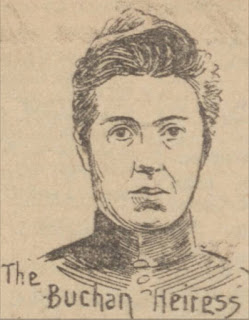
 Such was the fascination with Margaret Reid that at least two newspapers published engraving-style pictures of her during 1898, a time when she was making a nuisance of herself in the Perth and Dunkeld areas.

Engraving of Margaret Reid published in The Dundee Evening Telegraph, 9th February 1898

Engraving of Margaret Reid published in the Edinburgh Evening News, 31st January 1898


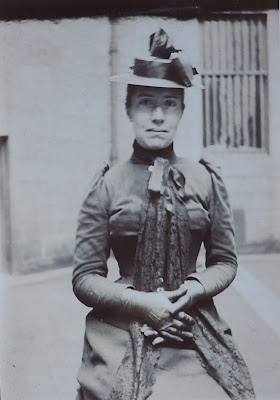
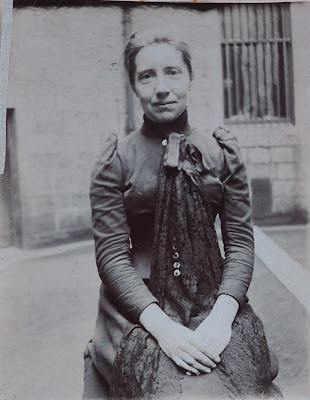
Publication of such images was rather unusual and undoubtedly reflects the public interest in the character of the Buchan Heiress and what might have driven a woman to commit such audacious crimes. Comparing the likeness of the newspaper images to the photographs at the top and bottom of the page, it would appear that The Dundee Evening Telegraph had access to the better artist.

In 1899, when she was found guilty at Edinburgh Sheriff Court of "victimising a widow" in Musselburgh, The Aberdeen Journal states that Margaret had ten previous convictions. By 1904 she had at least two more from courts in Glasgow and Edinburgh. The reports of these cases provide a little more by way of background information on Margaret: The Aberdeen Journal of 22nd February 1902 recounted that, 

"Lucy Gill, better known as Margaret Isabella Reid, the "Buchan heiress", who several years ago carried on a long series of swindles in different towns in the country, appeared yesterday in Justiciary Buildings, Jails Square, Glasgow, charged with several frauds committed in Glasgow and neighbourhood. The accused was quietly dressed in black, and pleaded guilty to all charges. Mr. C.B. Thomson, on her behalf, stated that her father was a man of means and used to be gas inspector at Invergordon. When the accused came from Brighton at the beginning of the year, after a term of imprisonment, she was compelled by sheer necessity to commit the crimes".

Margaret had evidently fallen on hard times in 1902, but come 1904 she is described as being "in service in Hawick as a nurse". 


Thomas Jackson or Johnston - A Theft at Braemar Followed by Escape From Forfar

According to The Weekly News  of Saturday November 21st 1885, Thomas Jackson (alias Johnston) was a joiner by trade who came originally from...