Thursday, August 26, 2021

Halford Percy Mills - The Paddington Swindler


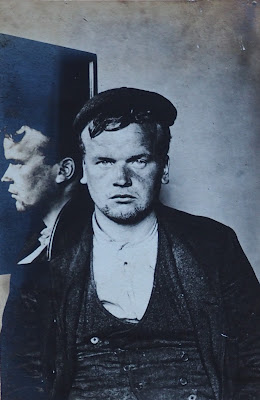
Halford Mills was arrested at Newtonhill railway station on Friday the 16th March 1900. Originally from London, his accent may well have aroused suspicion when he claimed to be a native of Shetland. The Aberdeen Journal of Monday 19th March 1900 reported his apprehension as follows,

"Constable Murray of the Kincardineshire Police, stationed at Portlethen, received a complaint on Thursday last from a salmon fisher at Findon to the effect that a "gentleman" representing himself as an engineer and a native of Shetland desired board and lodgings as he had a week to spare before his ship sailed to carry him home. He got the lodgings but abruptly disappeared on the 14th and did not pay his bill. The constable instituted enquiries in the course of which he landed at Newtonhill Railway Station on Friday evening, a few minutes before the departure of the last train for the south. While waiting, he observed a man, who answered the description of the party he was in search of, making inquiry of the railway officials regarding a train to take him to Dundee. The constable, after some questioning, took him into custody and conveyed him to Stonehaven, where he gave the name of Halford Percy Mills, 21 years of age, and stated that he was a native of London". 

If having the audacity to impersonate a Shetlander wasn't bad enough, it transpires from the newspaper report that Halford was also wanted for a string of other offences, 

"...he is at present wanted by the Aberdeen police for an extensive fraud committed in October last, and also in England by the Hants and Birkenhead police for fraud and felony. He is likewise believed to be identical with a board and lodgings imposter and thief at present wanted by the Forfar, Dundee, Perth and Coatbridge police. Mills was taken to Aberdeen on Saturday by the Aberdeen police. He is wanted in the city in connection with a charge of fraud by obtaining a suit of clothes under false pretences".

Unfortunately it has not been possible to trace where or when Halford was tried for his crimes. However, given his unusual first name, it was possible to locate him on the 1891 and 1881 census returns when he was aged 13 and 3 respectively. In 1891 he had five siblings, while both census returns show that the family was living at 31 Cambridge Place in Paddington. His father, also named Halford and originally from Smarden in Kent, was an undertaker, while his mother was originally from Barking, East London.


Detail of map showing Cambridge Place, Paddington, London
OS London 1:1,056 - Sheet VI.89
Published 1895
Reproduced by permission of the National Library of Scotland 
https://www.nls.uk/


Friday, August 20, 2021

George Martin - "An Attempt to Wreck a Train"


George Martin was a labourer, of no fixed abode, who claimed to be from the Dumfries area. The Aberdeen Press & Journal described his crime under the headline of "A Silly Prank", although it was a prank that could have had serious consequences. The newspaper of the 28th September 1904 reported that on Sunday 19th September,

"...he was on his way to Elgin to work when he met another labourer from London who was also on his way north to work. The man whom the accused met had a bottle of whisky on him, and both drank the contents. The London man suggested that they should put planks on the railway [between Oyne and Pitcaple], in order to wreck a train, and between them they managed to put two planks on the metals. Accused's statement was that afterwards he fell asleep by the side of the railway, where he lay until he was awakened by the noise of a passing goods train. Accused subsequently came to Aberdeen and reported what he had done and gave himself up. Accused was 24 years of age and had never been in trouble before".

Depending on your point of view, you could say that George was either incredibly honest or incredibly stupid. The driver of the train had apparently not even noticed that the engine had harmlessly pushed the obstructions off the track and, had George made himself scarce, he would almost certainly have escaped with little more than his whisky-induced hangover. His partner in crime from London was never traced, while George's actions and honesty perplexed the sheriff who ordered that George be medically examined before sentence was passed.

The examination came to the conclusion that while there was undoubtedly "a certain amount of mental weakness" observable in George, he was not insane and was consequently sentenced to two months' imprisonment.

Monday, August 16, 2021

James Morren - "He said he did not know what was being done when the crime was committed"


James Morren was one of four men convicted in January 1901 in connection with the theft of £54. 4s. 3d., from the offices of Adam & Company, 42 Regent Quay, Aberdeen. He was represented in court by his solicitor, Mr. Donald Sinclair, who made strenuous efforts to downplay James's role in the affair, saying that by keeping a look out for the police, he had only played a "minor part" in the theft and because he was young and from a respectable family, he should therefore be treated with leniency. The Sheriff, however, was having none of it. As The Aberdeen Journal of the 23rd January 1901 reported, 

"Mr Thomas Maclennan, Depute Procurator Fiscal, said that the accused had kept his eye on the police while the others had committed the theft. Mr Maclennan again recounted the circumstances of the theft stating that one of the men pretended to be drunk, and, going to the edge of the quay, drew away the old watchman's attention while two of the thieves broke into the office, and Morren kept his eye on the police. Morren afterwards left town, and was only apprehended on the 19th December. He denied the crime until four days ago, when his agent intimated that he would plead guilty. The other men who shared in the crime were Tindall, who got eight months; Mann who got six months; and Mackenzie, who acted as decoy, and who got 30 days' imprisonment. The sheriff saw no reason to differentiate between Morren's case and that of the others. He would therefore have to go to prison for six months".

James Morren was incarcerated in Craiginches Prison, Aberdeen, appearing as a prisoner there on the 1901 census. James's occupation is given as an "able seaman", with his birthplace being Aberdeen. Although it has not been possible to locate him on the 1911 census, he does appear as an eight year old on the 1891 census, living with his parents and six siblings, who were aged between three and eighteen, on Princes Street, Aberdeen. His father and mother, William and Margaret, were both forty-two, with William's occupation given as a stone cutter. 

The Princes Street area where James Morren lived as a child in the 1890s
Reproduced by permission of the National Library of Scotland
Ordnance Survey - Aberdeenshire LXXV.11 (Aberdeen) Revised: 1899 to 1900, Publication date: 1902


Tuesday, August 3, 2021

David Wood - The Commercial Traveller and a Dirty Deed


This mugshot of David Wood taken on his arrest in October 1904 when he was 36, portrays him as a well groomed, dapper individual sporting a neatly trimmed moustache. His clean and natty appearance betrays his occupation as that of a travelling salesman for the Vinolia Soap Company for which he had worked for a total of twelve years, apart from a brief spell with the rival Crown Perfumery Company.

A Vinolia Soap Company newspaper advertisement from 1900

David Wood's crime was embezzlement of £11 8s.6d. from his employer, with the misdemeanour first coming to light in Aberdeen, hence his trial in the city. The Aberdeen Daily Journal of Saturday 15th October 1904 carried a report of the proceedings in which it was mentioned that Wood was a married man and that his home address was Viewforth, Edinburgh. The trial heard that Wood, 

"...travelled from Dundee and Perth all over the north of Scotland, to Orkney and Shetland, and for this he was allowed £2 a week and £3 of travelling expenses. Wood stated that that amount was quite insufficient to meet the expenses in covering the ground which he had to go over, and what he did with the money he embezzled was to spend it on the expenses he incurred in connection with the firm's business. There was nothing against Wood's character. He was a married man. He was extremely sorry that he had allowed himself to be tempted to commit the act of embezzlement, and if the Sheriff gave him the option of a fine, he would be able to get hs friends in Edinburgh to pay back the money which he had taken".

However, the presiding sheriff, Sheriff Begg, was none-too impressed when Wood's taste for high living was revealed during the course of the trial:

"The accused had lived in first-class hotels wherever he went and if he found that his expenses were too heavy, he should have lived in less expensive hotels...The Sheriff said that it was impossible to let Wood off with with a fine as an offence of this kind was very serious. Accused might account himself lucky in being tried in a summary court, and not before a jury. Sentence of one month's imprisonment was passed".


Friday, July 16, 2021

John Ross - "This Drunken Freak"


According to the pencil note above John Ross's photograph, he came from Lossiemouth. Perhaps it was his new-found freedom or the excitement of the bright lights of Aberdeen, but he soon found himself in trouble after moving to the big city. The Aberdeen Daily Journal of Saturday 29th September 1906 reported his trial under the headline "Aberdeen Housebreaker Sent to Prison", 

Before Hon. Sheriff Substitute Henry Peterkin, at Aberdeen yesterday, John Ross, coppersmith, was charged with having broken into premises adjoining a bakehouse at 93 George Street with intent to steal. He pleaded guilty. Mr. George Mackenzie, solicitor, who appeared for the accused, stated that the prisoner was a coppersmith to trade and came to Aberdeen about four months ago. So far as he (Mr. Mackenzie) knew, there was nothing against the accused before and it was certainly very unfortunate that he should have been tempted to break into those premises with intent to steal. The explanation was that he was the worse for drink and could not understand how he had let himself commit this drunken freak. Nothing had been stolen. Mr. T. Maclennan, Procurator Fiscal Depute, stated that the accused was caught before he had time to take anything. The sentence was two month's imprisonment. 

Tuesday, July 13, 2021

Arthur Ross - "The Accused's 'Speciality' Appeared to be the Theft of Horse-Hair"


A newspaper report from The Aberdeen Daily Journal of 31st August 1901 records that Arthur Ross had spent a combined total of eight of the last fourteen years in prison having been incarcerated on multiple occasions. However, he wasn't so much a hardened criminal as a minor nuisance. His very long list of petty crimes were as a result of trying to eek out an existence, but also having the unfortunate habit of getting caught in the process. He is variously described as a "vagrant" or as having "no fixed abode". The report from the Aberdeen Daily Journal describes the items that Ross was caught with on that occasion: 

"Arthur Ross, a vagrant, was yesterday morning convicted at Inverurie Police Court of having in his possession a bag containing 2lb of horse hair, 7 duck eggs, 2½lbs of hard [salted] fish, and 1½lbs of cheese, without being able to give a satisfactory account of how he obtained the goods. The accused pleaded guilty and Provost Jackson, in sentencing him to imprisonment for 60 days said he could not impose a smaller penalty looking to the accused's previous record and character. There had been twenty-one previous convictions, involving terms of imprisonment ranging from six days to fifteen months".  

Some six months earlier, on the  25th February 1901, The Aberdeen Daily Journal reported one of Arthur Ross's previous convictions which also featured the theft of horse-hair. The report again refers to Arthur as being of no fixed residence and that he was a "native of Ross-shire". It also states that he had "about 40 previous convictions recorded against him" an inflated figure from that recorded in The Aberdeen Daily Journal, quoted above. Arthur evidently caused much amusement in court by promising to reform his character. However, the sheriff remained straight-faced, dourly stating that,

"...during the past 24 years, the man had been many years in prison, and the stuff stolen did not amount to more than £20...it was not really worth the man's trouble".

A subsequent newspaper report some three years later, from The Aberdeen Daily Journal of 23rd November 1904, records more of Arthur's antics when he was again tried for stealing horse-hair from the farms of Haremoss, Monquhitter, Honeynook, also in Monquhitter, and the Mains of Tollo, Inverkeithny, Banffshire. At the trial the Sheriff said, 

"...the accused's "speciality" seemed to be the theft of horse-hair. Apparently his method was to go about the country in the darkness of the night, enter the stables and steal the hair, and when he had collected a sufficient quantity, sell it. He had been 26 times previously convicted, and a great proportion of the thefts were connected with horse hair. His lordship repeated the last sentence - eighteen months' imprisonment, with hard labour"

Frustratingly, but perhaps not surprisingly given his itinerant lifestyle, it has proved impossible to locate Arthur on any of the likely census returns. A tantalising note in pencil above his mugshot that reads, "Arthur Ross, horse-hair thief, many convictions, now insane, 1905" would tend to suggest that a life of vagrancy and the revolving door of prison, may well have take its toll on his mental health.

Monday, July 5, 2021

Albert Becker - Fingerprint Technology Comes to Aberdeen


Albert Becker was a professional swindler who was apprehended in Huntly in November of 1904 after conning a number of clergymen of the Episcopal Church  out of sums of money ranging from 2s 6d. to 10s 6d. Becker was evidently adept at spinning a hard luck story that induced listeners to put their hands in their pockets on the promise of being repaid by his well-to-do sister at a later date.

He was known by several aliases including, Albert Heintz, John Muller, John Kind, John Ernest Becker, Gustavus Schaffer and Albert Deckers and had a long list of similar crimes recorded against him at, among other places, Nottingham, Exeter, Northampton, Wrexham, West Sussex, Windsor and Durham. The Aberdeen Press and Journal of the 12th November 1904 notes that in 1903 he had received 12 months' imprisonment for the offence committed at Durham, 

"...so that he had just been liberated when he once more resumed his old tactics, his field of operations on this occasion being Scotland and his dupes chiefly clergymen...The man, who is said to be of German extraction, has been removed to Dundee to answer charges brought against him there, and from Dundee he will be sent onto Perth where he is also "wanted". Since the date of his apprehension fresh charges have been proffered against him in Aberdeen and it is not unlikely that others may yet be forthcoming".

The newspaper report goes on to say that,  

"The identification of the accused was effected through the system now practised of taking fingerprints, and this is the first occasion, it is believed, on which the system has been put in to practise successfully in Aberdeen. The prints of the fingertips taken on a sheet of paper were forwarded to Scotland Yard, and an answer was received by return giving the career of the man in custody. The man was also photographed, but the identification through the fingerprints was established without the aid of the photographs. Whether the man is a German or not, he has an intimate knowledge of Germans and Germany. The geography of the country is well known to him, and, it is said, he would keep a clergyman amused for nearly an hour with an account of his doings in the Fatherland". 

That fingerprint technology was used in this case is illustrative of how the science was being used and adopted by police forces across the United Kingdom: bear in mind that that the first conviction in this country to be based on this new branch of forensic science was just over two years earlier, in September 1902. 

Thomas Jackson or Johnston - A Theft at Braemar Followed by Escape From Forfar

According to The Weekly News  of Saturday November 21st 1885, Thomas Jackson (alias Johnston) was a joiner by trade who came originally from...